

When it comes to employing people over 55, the UK ranks 21st out of 35 countries. PwC’s Golden Age index has Iceland, New Zealand and Israel at the top of the league. One way of interpreting all this is that nations could be richer if people had longer working lives. Potentially to the tune of $3.5 trillion if everyone across the OECD had similar older-folk job rates as New Zealand.
The number-crunchers at the Big Four accounting firm say: “GDP could be boosted by about £180 billion a year if the UK could match New Zealand’s employment rates for the over-55s.”
However, the prospects of that happening don’t look that rosy at the moment. PwC reckons: “Up to 23% of UK jobs currently held by 55+ workers could be displaced by automation technology in the next decade.”
Improved in the UK
But they do say that employment of older workers has improved in the UK in recent years.
The index is a weighted average of indicators – employment, earnings and training – that reflect the labour market impact of workers aged over 55.
Employment rates of older workers differ across the country, ranging from 75.3 per cent in the south-east, to 63.2 per cent in Northern Ireland.
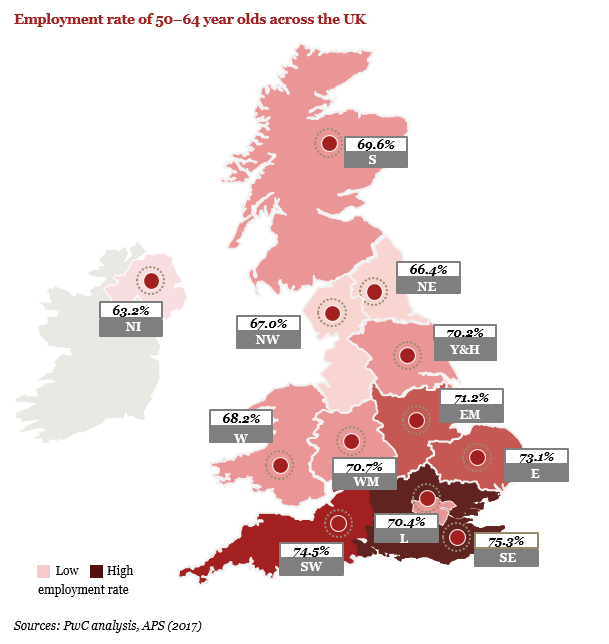
PwC says there are three key reasons for these differences:
- regions with lower older worker employment rates tend to be the lower performing regions and have lower overall employment rates too.
- regions with a greater proportion of older workers with degrees tend to have higher employment rates.
- lower older worker employment rates are often driven by lower female employment rates, with these low-performing regions tending to have a greater disparity between male and female employment rates. For example, in Northern Ireland, the difference between female and male employment for over 50s is about 12 percentage points.
John Hawksworth, PwC chief economist, says: “The UK needs to pick up the pace in increasing employment for older workers to keep up with the likes of Germany, which has climbed the rankings from 21st to 14th place.”
Automation technology
In the UK up to 23 per cent of jobs currently held by 55+ workers could be displaced by automation technology in the next decade. In particular, technology is likely to be used to complete tasks such as clerical support and simple decision making.
This potential risk to older workers is greater than the average for workers of all ages in the UK (20 per cent). Older female workers face a higher risk of job automation compared to their male counterparts within the next 10 years.
Dynamic issues
Looking further into the future, expectations for technological advancements in physical labour and problem solving of dynamic issues could further increase the risk associated with job automation to an average of 32 per cent for older workers by the mid-2030s.
But the report also emphasises that AI and robotics will boost economic growth, leading to new job creation for workers who can adapt to these new technologies.
Hawksworth adds: “The ability to adapt to new technologies and a rapidly evolving working environment is crucial for people looking for employment in later life. AI technology can boost economic growth, generate more labour demand and support longer working lives.”


